Tank Inspection Support Using Rope Access: Safer, Faster, No Scaffolding Needed
Tank inspections are rarely delayed because inspectors are unavailable. More often, they stall because access is not ready. On industrial sites, tanks are frequently located in congested areas, elevated positions, or operating facilities where building temporary access is complex, time-consuming, and disruptive. For project managers, this creates a familiar problem: the inspection scope is defined, the inspector is booked, but access becomes the critical path.
This is where tank inspection services supported by rope access change how inspections are planned and executed. Rather than overbuilding access for areas that may only require brief visual assessment, rope access allows inspection teams to reach exactly where they need to go, safely, efficiently, and with minimal impact on the site.
Why Access Is the Bottleneck in Many Tank Inspections
On paper, tank inspections are straightforward. Inspectors need to visually assess shell condition, welds, nozzles, roofs, or internal surfaces depending on the scope. In practice, access often dictates how much of that scope can actually be completed.
Industrial tanks are rarely isolated. They sit among piping, equipment, structures, and live operations. Shutdown windows are limited, and inspection durations are often short. When access planning does not match these realities, inspections are delayed, compressed, or broken into multiple phases.
For project managers, this creates schedule risk and coordination challenges that have nothing to do with inspection quality and everything to do with access strategy.
What “Tank Inspection Services” Mean in This Context
It is important to be clear about roles. Tank inspection services typically involve certified third-party inspectors responsible for evaluating condition, identifying defects, and determining compliance with applicable standards or owner requirements.
Rope access teams do not replace that role. Instead, they support tank inspection services by providing safe, controlled visual access to inspection areas that would otherwise be difficult or impractical to reach. Their responsibility is access, positioning, and safety systems—not inspection authority or certification.
This separation of roles allows inspectors to focus on assessment while access specialists ensure they can reach the right locations efficiently.
The Problem With Overbuilt Access for Visual Inspections
Many tank inspections require targeted visual assessment rather than continuous access around the entire structure. However, access solutions are often designed as if every surface must be reached equally, regardless of actual inspection need.
This mismatch leads to unnecessary complexity. Time is spent mobilizing access that may only be used briefly, and site disruption increases as more space is taken up by temporary systems. In live facilities, this can introduce additional safety risks related to congestion and simultaneous operations.
From a project management perspective, the issue is not that access is unsafe, it is that it is frequently misaligned with the inspection scope.
How Rope Access Supports Visual Tank Inspections
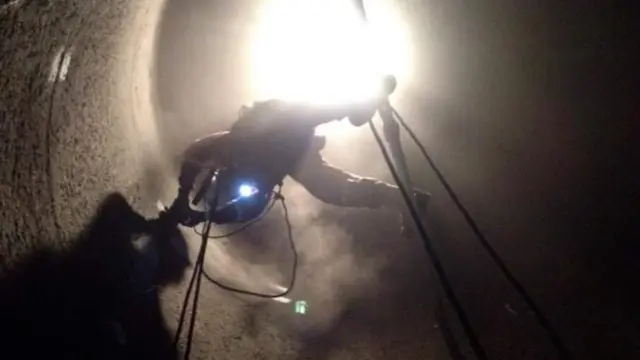
Rope access inspection support is built around flexibility. Access technicians can position inspectors precisely where visual confirmation is required, move with the inspection as findings evolve, and disengage once the assessment is complete.
If an inspector identifies an area requiring closer review, access can be adjusted in real time without rebuilding systems or halting work. This responsiveness is particularly valuable during exploratory or condition-based inspections, where the scope may change as information is gathered.
For tank inspection services, this means inspection effort stays focused on evaluation rather than logistics.
Safety and Control During Inspection Support
For project managers, safety is not negotiable, especially when inspections occur at height or in constrained environments. Rope access inspection support operates under strict safety frameworks, including defined rescue capability, redundant systems, and clear role separation between access and inspection functions.
Organizations such as IRATA International establish globally recognized standards governing rope access training, supervision, and execution. These standards ensure that access systems are planned, reviewed, and implemented with safety as the primary control.
When integrated correctly, rope access does not introduce additional risk. Instead, it provides a controlled method of reaching inspection areas without expanding the site footprint.
Scheduling Advantages for Project Managers
One of the most immediate benefits of rope access inspection support is scheduling flexibility. Access systems can be mobilized quickly, adapted to short inspection windows, and removed without extended demobilization periods.
This allows tank inspection services to proceed when access would otherwise delay the start of work. In shutdown scenarios, rope access can be aligned with inspection sequences rather than dictating them. In live environments, inspections can often be completed without altering normal operations.
For project managers juggling multiple stakeholders, this flexibility reduces pressure on schedules and limits the cascading impact of inspection delays.
Matching Access Effort to Inspection Need
Not every tank inspection requires full-surface access. Many inspections are localized, confirmatory, or focused on known areas of concern. Rope access supports these inspections by allowing access effort to scale with inspection need.
This precision helps avoid the common situation where access planning assumes worst-case requirements. Instead, access is deployed where inspection value is highest, and resources are conserved elsewhere.
For projects with tight budgets and timelines, this approach supports better alignment between scope, cost, and outcome.
Integrating Rope Access Into Inspection Planning
The most successful tank inspection services are planned collaboratively. When project managers involve access specialists early, alongside inspectors, access strategies can be tailored to inspection objectives rather than retrofitted later.
Early coordination clarifies where access is truly required, how inspectors will move through the scope, and how safety responsibilities are managed. This reduces last-minute changes, improves predictability, and supports smoother execution on site.
Rope access works best when it is treated as part of inspection planning, not as an afterthought.
Tank Inspection Support Is About Precision, Not Speed
While rope access can shorten timelines, its real value lies in precision. By matching access to inspection requirements, it allows inspections to be completed thoroughly without unnecessary build-out or disruption.
For project managers, this means fewer compromises between safety, schedule, and inspection quality. Tank inspection services supported by rope access are not about doing more work faster, they are about doing the right work with the right level of access.
When access is aligned with inspection intent, inspections become easier to plan, safer to execute, and more reliable in their outcomes.
For projects requiring flexible, site-specific access, rope access inspection support can be integrated into tank inspection planning to reduce disruption and improve execution.