How Rope Access Concrete Repair Works on High-Angle & Over-Water Structures
Why High-Angle Concrete Repair Requires a Different Approach
Concrete deterioration rarely happens where access is easy. On bridges, marine structures, and elevated infrastructure, damage often appears on soffits, piers, columns, and vertical faces that are difficult to reach and even harder to repair without disruption. These are environments where gravity, exposure, and access constraints fundamentally change how concrete work must be planned and executed.
High-angle concrete repair is not simply standard concrete repair performed higher off the ground. The angle of the work, the surrounding environment, and the consequences of falling debris introduce challenges that demand a different approach. On over-water and live-traffic structures, traditional access methods such as scaffolding, lifts, or barges can be slow to mobilize, costly, and disruptive to operations. This is why rope access concrete repair is increasingly used, not as a shortcut, but as a way to control risk, reduce downtime, and execute repairs precisely where they are needed.
What High-Angle Concrete Repair Typically Addresses on Infrastructure
High-angle concrete repair most often deals with deterioration caused by environmental exposure and long-term service conditions. On bridges and elevated structures, water infiltration, chloride exposure, freeze-thaw cycles, and carbonation can lead to cracking, spalling, and exposed reinforcement. Over time, these issues compromise both durability and safety.
Because these defects frequently occur on undersides or vertical faces, they can progress unnoticed. Visual inspections from the ground may identify symptoms, but they rarely reveal the true extent of damage. By the time deterioration becomes obvious, repair scopes are often larger and more complex than they would have been with earlier intervention. Effective high-angle concrete repair focuses on addressing deterioration before it escalates into structural or operational risk.
Why Inspection Drives High-Angle Concrete Repair Decisions
Inspection is the starting point for any successful high-angle concrete repair strategy. Close-access inspection allows engineers and repair teams to assess the extent of cracking, delamination, corrosion activity, and material loss directly at the repair surface. This level of access is critical for determining whether repairs are localized or symptomatic of broader deterioration.
Rope access enables inspectors to evaluate concrete conditions without the delays associated with large access systems. This makes it possible to gather accurate information quickly, which supports better decision-making around repair methods, materials, and sequencing. Without proper inspection, high-angle concrete repair risks becoming reactive, addressing visible damage while underlying issues continue to develop.
Why Rope Access Is Used for High-Angle Concrete Repair
Rope access has become a preferred access method for high-angle concrete repair because it minimizes the footprint required to reach complex locations. Technicians can access vertical, inverted, or over-water surfaces directly, without the need for extensive scaffolding or heavy equipment.
From a project perspective, this approach reduces mobilization time and limits disruption to traffic, waterways, and surrounding operations. Rope access concrete repair also allows teams to adapt quickly to changing site conditions, which is particularly important on exposed structures where weather and access windows can shift unexpectedly.
Rather than dictating how repairs must be performed, access becomes a flexible tool that supports efficient execution.
How Rope Access Concrete Repair Is Performed On Site
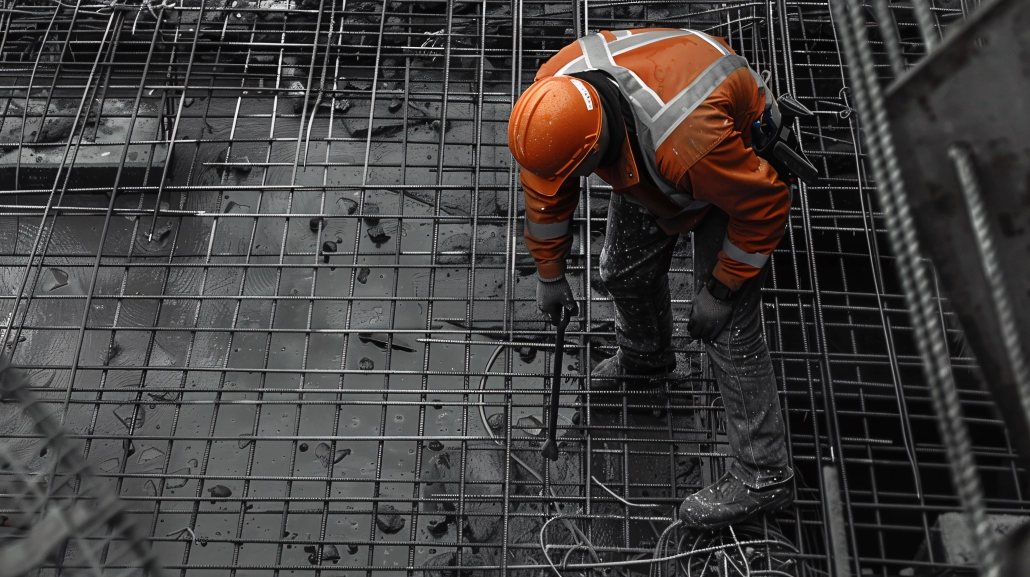
Once a rope access team mobilizes, the work begins with establishing safe and controlled access to the repair area. Systems are installed to allow technicians to move efficiently while maintaining continuous protection. In high-angle and over-water environments, additional controls are implemented to manage debris and protect surrounding areas.
Concrete repair itself follows the same fundamental principles as ground-level work, but execution is adapted to the vertical or inverted orientation. Deteriorated concrete is removed carefully to expose sound substrate and reinforcement. Corroded steel is cleaned and treated, and repair materials are applied in a manner that ensures proper bonding and curing despite gravity and exposure.
Throughout the process, technicians must manage materials, tools, and environmental conditions simultaneously. This requires coordination and experience, as improper sequencing or curing can compromise repair performance. Rope access concrete repair is therefore as much about execution discipline as it is about access.
Managing High-Angle Concrete Repair Over Water and Live Environments
Over-water structures and live infrastructure introduce additional complexity to high-angle concrete repair. On bridges and marine assets, debris containment is critical to protect waterways, vessels, and ecosystems. Traffic management and public safety considerations further constrain how and when work can occur.
Rope access reduces many of these challenges by limiting the amount of equipment suspended over water or active corridors. With fewer materials and structures required, the risk of accidental drops or environmental impact is reduced. This makes rope access particularly well suited for bridge repair projects where maintaining operations is a priority.
Careful planning and coordination remain essential, but the reduced footprint of rope access allows work to proceed with fewer external dependencies.
Quality Control and Longevity in High-Angle Concrete Repair
Ensuring repair quality is especially important when work is performed at height. Post-repair inspection confirms that repairs have been executed correctly and that materials have cured as intended. Documentation of repair conditions and outcomes provides a record that supports future maintenance planning.
High-angle concrete repair is often undertaken to extend asset life rather than achieve cosmetic improvement. Quality control ensures that repairs address root causes of deterioration and deliver long-term performance. Without this verification, repairs may need to be repeated sooner than expected, increasing lifecycle cost.
Common Misconceptions About High-Angle Concrete Repair
A common misconception is that all bridge repair and elevated concrete work requires large scaffolding systems. In many cases, this assumption leads to unnecessary delays and higher costs. Another misunderstanding is that rope access limits the quality or durability of repairs. In reality, when performed correctly, rope access concrete repair meets the same technical standards as traditional methods.
There is also a tendency to view high-angle repairs as temporary measures. While some repairs are interim by design, many rope access repairs are permanent solutions that restore structural performance and durability.
Understanding how the work is actually executed helps dispel these assumptions.
When High-Angle Concrete Repair Should Be Performed Versus Deferred
Not all concrete deterioration requires immediate intervention, but deciding when to act depends on accurate assessment. Inspection findings guide whether repairs should be executed promptly or scheduled as part of a planned maintenance cycle.
Deferring certain types of damage, particularly on over-water or exposed structures, can accelerate deterioration and increase repair scope later. Early high-angle concrete repair often reduces long-term cost and minimizes disruption by addressing issues while they remain localized.
High-Angle Concrete Repair Is About Access, Control, and Execution
High-angle concrete repair demands more than technical knowledge of concrete materials. It requires an approach that integrates access planning, environmental control, and disciplined execution under challenging conditions. Rope access concrete repair enables this work to be carried out safely and efficiently on bridges, marine structures, and elevated assets.
For project managers and asset owners, understanding how these repairs are actually performed supports better planning, more realistic scheduling, and fewer surprises during execution. When access and execution are aligned, high-angle concrete repair becomes a controlled maintenance activity rather than a disruptive event.