Rope Access Inspections: Why Traditional Inspection Methods Often Fail
For safety and HSE leaders, inspections are not just a technical requirement—they are a frontline control against incidents, failures, and regulatory exposure. When inspections fall short, risks don’t disappear. They go undocumented, unmanaged, and unresolved until they surface as incidents, near misses, or audit findings.
Many inspection programs fail not because teams are careless or undertrained, but because the inspection method itself limits what can be seen, reached, or verified. In environments where assets are elevated, complex, or difficult to access, traditional inspection approaches often introduce blind spots that undermine safety objectives. This is where rope access inspections change the equation.
Why Inspection Failure Is Often an Access Problem
Most inspection shortcomings trace back to one root cause: inspectors cannot safely or practically reach the areas that matter most. As a result, inspections are adapted to what is accessible rather than what is critical.
From a safety perspective, this creates a dangerous mismatch. Hazards such as corrosion, cracking, loose fixings, degraded coatings, or structural movement rarely occur in convenient locations. They develop on undersides, vertical faces, interfaces, and transition points that are difficult to observe from a distance.
When inspectors are forced to rely on partial visibility, indirect observation, or assumptions about condition, the inspection may appear complete on paper while leaving real risks unaddressed.
The Limits of Visual-Only and Distance-Based Inspections
Visual inspections performed from the ground or from fixed vantage points are often treated as sufficient for routine assessments. While these methods can identify obvious defects, they struggle to detect early-stage issues that pose long-term safety risks.
Hairline cracking, early corrosion, coating breakdown, or minor displacement may not be visible without close access. Over time, these small issues can evolve into significant hazards that affect structural integrity or worker safety.
For HSE leaders, this creates a false sense of security. Documentation may indicate that inspections were completed, but the data collected may not be robust enough to support confident risk assessments or maintenance decisions.
How Rope Access Inspections Address These Gaps
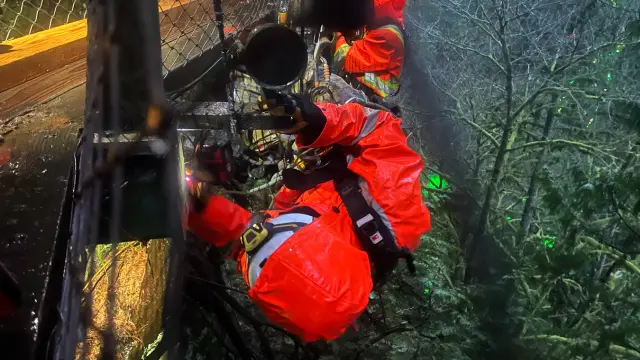
Rope access inspections are designed to eliminate the access limitations that undermine inspection quality, allowing safety teams to verify conditions directly rather than relying on assumptions.
By allowing trained inspectors to reach elevated, vertical, or inverted surfaces directly, this method enables close-contact assessment without compromising safety.
Rather than inspecting around obstacles or from a distance, inspectors can position themselves exactly where hazards are most likely to develop. This improves defect detection, condition assessment, and confidence in inspection findings.
For safety programs, the benefit is clear: risks are identified based on observed conditions, not inferred ones.
Safety Standards Behind Rope Access Inspections
Rope access inspections are governed by rigorous safety frameworks. IRATA International establishes global standards for training, supervision, equipment, and rescue planning through its Code of Practice.
These standards require redundancy in access systems, formal risk assessments, and competency verification for all personnel involved. For HSE leaders, this provides assurance that rope access inspections are not improvised solutions, but structured operations designed to control risk in challenging environments.
The result is an inspection method that prioritizes both access safety and inspection integrity.
Inspection Quality and Hazard Identification
One of the most significant advantages of rope access inspections is the improvement in hazard identification. Close access allows inspectors to verify conditions directly, confirm severity, and distinguish between cosmetic issues and safety-critical defects.
This level of detail supports more accurate risk registers, clearer maintenance priorities, and better-informed safety decisions. It also reduces reliance on conservative assumptions that can lead to unnecessary restrictions or reactive interventions later.
For HSE leaders, improved inspection quality translates into stronger defensibility during audits and incident investigations.
Rope Access Inspections in Live and High-Risk Environments
Many industrial and infrastructure assets must remain operational while inspections are conducted. In these live environments, inspection methods that require extensive site disruption can introduce additional safety risks, including congestion, simultaneous operations, and restricted egress.
Rope access inspections are well suited to these conditions because they require minimal physical footprint. Access systems are localized, allowing inspections to proceed without altering site layouts or interfering with ongoing work.
This supports safer coordination between inspection teams and operations, reducing secondary risks introduced by the inspection process itself.
Documentation, Compliance, and Audit Readiness
From a compliance standpoint, the value of an inspection lies not only in identifying hazards, but in documenting how risks were assessed and controlled. Rope access inspections produce clearer, more defensible records because findings are based on direct observation.
Photographic evidence, condition descriptions, and inspector notes are tied to specific locations and access points. This level of documentation strengthens compliance reporting and supports transparent communication with regulators, insurers, and internal stakeholders.
For HSE leaders, this clarity reduces ambiguity and strengthens confidence in inspection outcomes.
Why Traditional Inspection Programs Struggle to Evolve
Inspection programs often persist with familiar methods because they appear simpler or more economical in the short term. However, when these methods fail to identify emerging risks, the long-term safety and financial costs increase.
Rope access inspections represent a shift toward risk-based inspection planning, where access is selected based on hazard exposure rather than convenience. This shift aligns inspection practices with modern safety management systems that emphasize proactive risk identification.
When Rope Access Inspections Should Be Considered
Rope access inspections are particularly effective when assets are elevated, complex, or difficult to reach; when safety risks are concentrated in localized areas; or when inspections must be performed without disrupting operations.
They are commonly used as part of baseline condition assessments, targeted follow-up inspections, and pre-maintenance evaluations where accuracy and safety are critical.
For HSE leaders, incorporating rope access inspections into the inspection toolkit provides flexibility to match inspection method to risk profile.
Rope Access Inspections Support Safer Decisions
At their core, rope access inspections are about improving decision-making. By removing access barriers, they allow safety leaders to base risk assessments on what is actually happening on the asset, not on assumptions or incomplete information.
Traditional inspection methods often fail quietly, leaving hazards undiscovered until consequences emerge. Rope access inspections address this failure mode directly, providing safer access, clearer insight, and stronger support for proactive safety management.
For organizations committed to preventing incidents rather than reacting to them, this approach delivers both safety and operational value.